

Angostura’s TT$984 Million Question: What Minority Shareholders Should Know


A nearly TT$ billion-dollar claim against CL Financial has moved from the footnotes of Angostura’s financial statements into a live corporate-governance debate. For minority shareholders, there are several important questions to ask before drawing conclusions.
A few weeks ago, I wrote about what I saw as one of the more interesting questions facing Angostura Holdings Limited shareholders.
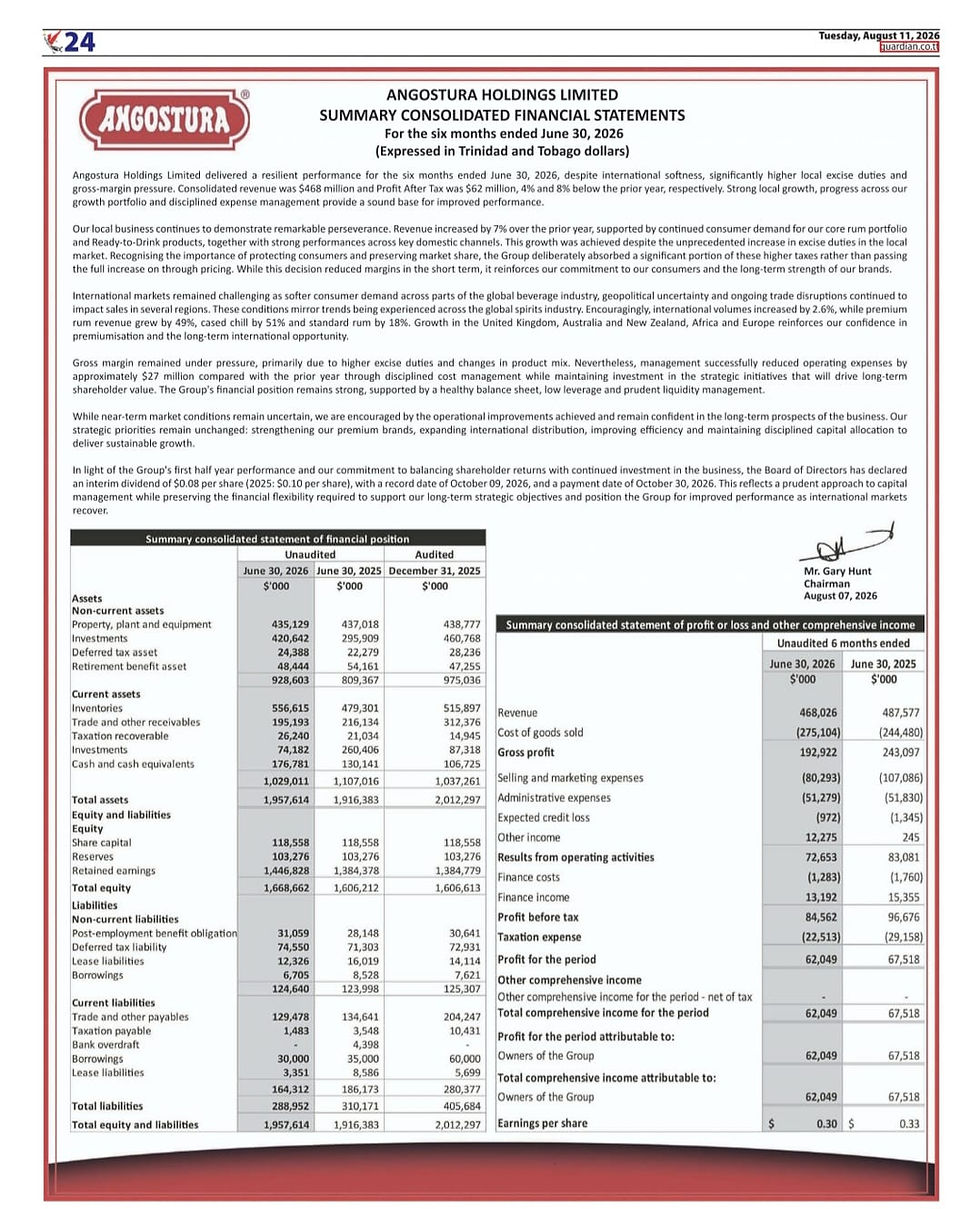
Angostura had approximately TT$672 million sitting in cash and financial investments, representing roughly one-third of the company’s assets. My question was not whether having a strong balance sheet was a bad thing. It was whether shareholders had enough clarity around what management intended to do with all that capital.
In other words: is Angostura’s balance sheet working hard enough for shareholders?
A new issue has now brought a different side of that same question into focus.
This time, it is not about the hundreds of millions of dollars Angostura already controls; it is about nearly TT$1 billion that Angostura says it is owed. And unlike the investment portfolio, this amount currently has a net carrying value of zero in Angostura’s accounts.
The Trinidad Guardian reported on August 24 that a shareholder campaign is urging investors to vote against the re-election of an Angostura director at the company’s August 26 Annual General Meeting. At the center of the dispute is Angostura’s approximately TT$984 million Proof of Debt claim against CL Financial Limited, which is in liquidation. The CLF liquidator rejected the claim, and Angostura is challenging that decision through High Court proceedings.
For shareholders, there are really two issues here.
The first is financial:
What could recovery of this claim mean for Angostura?
The second is governance:
Is Angostura’s Board sufficiently independent to pursue that recovery solely in the interests of Angostura itself?
Those questions deserve to be separated.
First, what exactly is this TT$984 million?
Readers who have followed my Angostura commentary may remember that I raised this issue about two years ago.
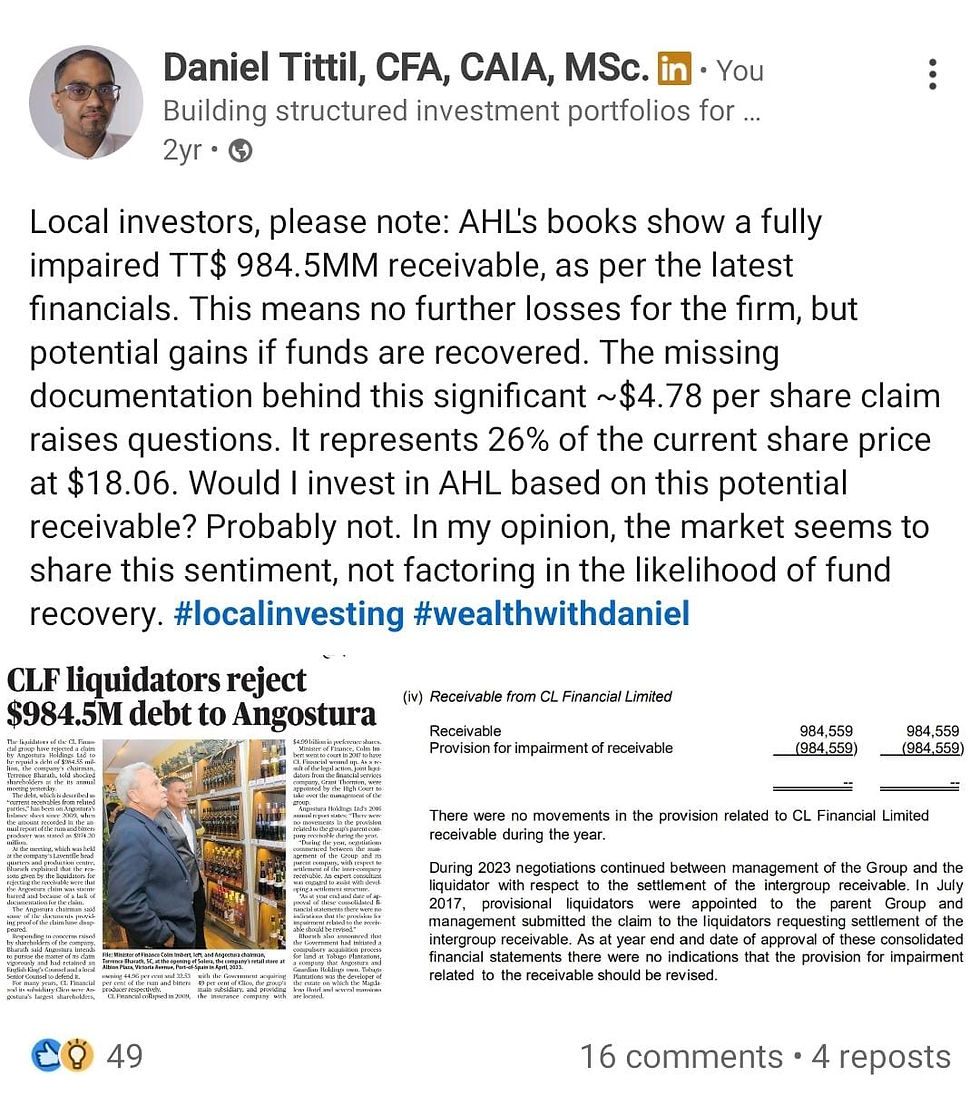
At the time, my focus was on the unusual asymmetry created by the accounting treatment. Angostura’s financial statements showed a TT$984.5 million receivable from CL Financial that had been fully impaired, leaving it with a net carrying value of zero. I noted then that the market appeared to be assigning little value to the possibility of recovery, even though the gross claim was highly material on a per-share basis.
I also highlighted concerns around the reported gaps in supporting documentation and questioned how investors should think about an asset that had effectively been written down to zero but could still produce meaningful upside if Angostura succeeded in recovering some or all of it.
Two years later, that accounting issue has become something much bigger: a live legal and corporate-governance question.
Angostura’s audited financial statements recognise a gross receivable from CL Financial Limited of TT$984.559 million, together with an equal TT$984.559 million impairment provision.
The result is a net carrying value of zero.
At December 31, 2024, that accounting treatment remained unchanged. Angostura said negotiations had continued with CLF’s liquidator and that there was no basis at that stage for revising the impairment provision.
This is not an asset currently contributing TT$984 million to Angostura’s reported book value. From an accounting perspective, the company has already provided for the possibility that it may recover nothing.
If Angostura ultimately recovers a meaningful amount, that recovery could potentially represent substantial incremental value relative to the amount presently recognised on its balance sheet.
But that does not mean shareholders should simply add TT$984 million to Angostura’s valuation today. There is a legal dispute and, thus, uncertainty over recoverability. There are questions about timing, creditor priority, interest, legal costs and potentially the accounting and tax treatment of any eventual settlement.
A dollar that might be recovered years from now is also not worth the same as a dollar sitting in Angostura’s bank account today.
Why was the claim rejected?
This dispute is not new.
At Angostura’s 2024 AGM, then-chairman Terrence Bharath disclosed that CLF’s liquidators had rejected the claim.
According to reporting at the time, the reasons given included an argument that the claim was statute-barred and concerns regarding supporting documentation. Bharath also said that some documents supporting the claim had disappeared, while telling shareholders that Angostura intended to pursue the recovery vigorously and had retained senior legal counsel.
That history makes a document highlighted in the latest Guardian story particularly significant.
According to the Guardian, a June 16, 2016 letter from CL Financial to Angostura stated that CLF’s Board had confirmed a liability of approximately TT$971.8 million and that arrangements would be made to develop a repayment schedule.
That document could clearly be relevant to Angostura’s case.
Whether it ultimately determines the legal outcome is another matter. That is for the Court to decide.
The governance issue
The latest controversy arises because the director seeking re-election under Resolution No. 4 has historical and continuing connections to entities associated with CL Financial.
According to the Guardian’s reporting on a draft shareholder letter, the director spent more than 12 years at CL Financial, including service as Corporate Secretary, and signed the 2016 acknowledgement of the liability in that capacity. The draft letter says she was subsequently identified as a potential witness in Angostura’s proceedings and alleges that she declined to participate in discussions regarding a witness statement when approached by Angostura’s external counsel in late 2025.
The Guardian also reports concerns surrounding her current CLICO role and other professional connections to entities within the broader CL Financial structure. The director declined to comment to the Guardian on the advice of legal counsel, while Angostura had not responded to the newspaper before publication.
These are allegations and governance concerns raised in a draft shareholder communication. They are not findings of misconduct by a court or regulator. Nor do we presently know everything that may be occurring inside the Angostura boardroom.
The Board may already have conflict-management procedures in place. The director may be recused from particular discussions. Independent directors or external counsel may be handling the litigation. There may be information barriers. There may also be legally valid reasons why a person advised by counsel would decline to provide a statement or discuss ongoing litigation.
Those possibilities should not be dismissed. But neither should the governance question.
What does the Board actually owe?
This is where Trinidad and Tobago’s Companies Act provides useful clarity. Section 99 requires every director and officer to act honestly and in good faith with a view to the best interests of the company, while exercising the care, diligence and skill of a reasonably prudent person.
Directors must have regard to shareholder and employee interests, but the Act expressly provides that the relevant duty is owed to the company itself.
This is especially important in a company with concentrated ownership. Rumpro Company Limited directly owns approximately 44.97% of Angostura. Rumpro is owned by CL World Brands. Angostura itself clarified in 2023 that, following litigation over CL World Brands’ ownership, CL Financial remained the controlling shareholder of CL World Brands.
The National Investment Fund Holding Company Limited owns another approximately 29.97% of AHL.
Together, those two blocks represent close to three-quarters of Angostura. But directors are not simply delegates sent to the boardroom to represent whichever shareholder nominated them.
Good corporate-governance practice requires directors to exercise objective and independent judgement. The OECD’s corporate-governance principles make the point particularly clear for companies with controlling shareholders: even where a director is associated with a controlling shareholder, the director’s loyalty at board level is to the company rather than to the controlling shareholder that may have helped put that person there.
That principle goes to the heart of the current Angostura debate.
Is Permell’s request reasonable?
Peter Permell is urging minority shareholders to vote against the director’s re-election.
I think it is important to distinguish between saying his position is reasonable and saying his conclusion has been proven.
The first, in my view, is fair.
The second goes further than the public evidence currently allows.
The claim is exceptionally material to Angostura. The director reportedly signed an acknowledgement of the underlying debt while acting as CLF Corporate Secretary. She has reportedly been identified as a potential witness. There are also ongoing professional and ownership relationships involving entities on the other side of Angostura’s recovery effort.
Those facts create a legitimate question about actual, potential and perceived conflicts of interest.
International governance practice recognises that when directors have relationships capable of affecting their judgement on an important matter, disclosure is necessary and non-participation in the relevant decisions is often appropriate. Boards are also expected to maintain sufficient independence to manage conflicts involving significant or controlling shareholders.
But conflicts do not automatically mean misconduct; they can sometimes be managed through disclosure, recusal, independent committees, separate legal counsel and strict information controls.
So my position would be this:
Permell has raised a governance issue sufficiently material that shareholders are entitled to a clear explanation from the Board.
Whether shareholders ultimately vote for or against the director is then a judgement about their confidence that she can discharge the responsibilities of an AHL director objectively while this litigation remains outstanding.
Shareholders do not need to prove misconduct in order to vote against a director.
Director elections are ultimately about confidence, independence and stewardship.
Want content like this straight to your inbox? Join our mailing list below.
How big is the claim for shareholders?
This is where the numbers become interesting. AHL currently has approximately 205.82 million shares outstanding. At a recent market price of approximately TT$10.01, Angostura’s equity market value is around TT$2.06 billion.
The TT$984.559 million gross receivable therefore represents approximately 48% of Angostura’s current market capitalisation!
On a simple per-share basis:
TT$984.559 million ÷ 205.82 million shares = approximately TT$4.78 per AHL share.
Again, TT$4.78 is not my estimate of what the claim is worth today.
It is simply the gross principal claim divided by the number of shares outstanding.
Any proper valuation would need to incorporate the probability of recovery, timing, interest, costs, and other factors.
But the calculation illustrates why this dispute is not an obscure legal footnote.
It is potentially enormous relative to the value the stock market currently places on Angostura.
A problem with the TT$8.20 figure
The Guardian article quotes Permell as estimating that successful recovery could represent approximately TT$8.20 in additional earnings per share.
I would be careful with that number.
TT$8.20 multiplied by approximately 205.82 million shares implies roughly TT$1.69 billion, considerably more than the TT$984.559 million gross receivable disclosed in Angostura’s accounts.
There may be an explanation.
A December 2025 legal notice relating to the ongoing CLF proceedings identifies multiple components or “tranches” of Angostura’s matter, including one specifically described as “BVD Tranche – Accumulated Interest.”
Permell’s calculation may therefore incorporate accumulated interest or additional claim components. But I have not been able to locate a public reconciliation taking shareholders from the TT$984.559 million receivable to TT$8.20 per share.
Until such a reconciliation is available, I would treat TT$8.20 as an estimate rather than an established financial value.
This is exactly the sort of number shareholders should ask the Board to clarify.
What good governance would look like
In my view, the most useful discussion is not about personalities; it is about process.
Angostura’s Board should be able to demonstrate that decisions relating to the CLF litigation are being made exclusively for Angostura’s benefit.
If a director has a material connection to the opposing party, good governance would normally point towards clear disclosure of that relationship, appropriate recusal from affected deliberations, independent directors overseeing the matter, independent legal advice and controls over access to privileged or commercially sensitive information.
For something approaching TT$1 billion, shareholders should also understand who has authority to instruct counsel and, importantly, who could approve or recommend any eventual settlement.
The Board does not need to disclose litigation strategy that could prejudice Angostura’s case. But protecting legal privilege is not the same thing as providing shareholders with no governance information at all.
It should be possible to tell shareholders how the conflict is being managed without telling CLF how Angostura intends to argue its case.
What minority shareholders can do
Angostura’s 44th Annual Meeting is scheduled for Wednesday, August 26, 2026 at 10:00 a.m. at the House of Angostura in Laventille.
This makes the issue unusually time-sensitive.
Minority shareholders who intend to participate should review the current AGM materials and proxy form immediately. If shares are held through a broker or other intermediary, shareholders should contact that institution promptly regarding the procedure for exercising their vote. Shareholders unable to attend physically should determine whether they can still submit a valid proxy within the applicable deadline.
I am not telling shareholders how they should vote on Resolution No. 4.
I am saying that an issue of this scale deserves an informed vote rather than a passive one.
For shareholders who attend the AGM, these are the questions I think matter most:
What formal conflict-of-interest declarations have been made concerning the CLF litigation, and which directors are recused from related deliberations?
Is the claim being overseen by a committee comprised exclusively of directors considered independent of CLF, Rumpro, CLICO and other materially connected parties?
Who instructs Angostura’s external counsel and who has authority to approve litigation strategy or any potential settlement?
Has the Board obtained independent legal advice specifically concerning the governance and conflict issues raised by the claim?
What is the current total quantum being pursued, including principal and accumulated interest, and how does that amount reconcile with the TT$8.20-per-share estimate now circulating publicly?
Without prejudicing the litigation, what safeguards are in place to ensure confidential information concerning Angostura’s case cannot reach parties whose economic interests may be adverse to AHL?
Those questions do not presume wrongdoing; they ask the Board to demonstrate that appropriate governance exists.
That is precisely what shareholders should be entitled to expect.
Minority shareholders matter more than the percentages suggest
Angostura’s ownership structure can make the position of an individual retail shareholder appear insignificant.
Rumpro owns approximately 45%.
NIF owns approximately 30%.
What difference can a few hundred or a few thousand shares possibly make? Collectively, quite a lot.
Shareholder voting is one of the fundamental mechanisms through which owners of publicly listed companies influence governance. International corporate-governance principles specifically recognise shareholders’ rights to information and participation in general meetings, while emphasising equitable treatment of minority shareholders.
The Guardian reports that Permell believes minority shareholder participation could be decisive depending on how NIF votes.
There is a broader lesson here.
Minority shareholder protection does not mean minority shareholders should determine corporate strategy. The company cannot be managed by referendum.
But it does mean directors must govern the company objectively, shareholders should receive sufficient information to exercise their rights intelligently, and controlling ownership should not translate into corporate decisions designed principally around the interests of the controller.
That is enormously important in smaller Caribbean capital markets where share ownership is often much more concentrated than in the United States or other large markets.
My view
This litigation should not be treated as a free TT$984 million asset when valuing Angostura. There is too much uncertainty for that. But neither should investors ignore it simply because the accounting carrying value is zero.
A claim equal to almost half of the company’s present market capitalisation is unquestionably material to the investment case. Likewise, I do not think the information presently available allows outsiders to conclude that an AHL director has breached her duties.
But the combination of the director’s historical involvement with CLF, the reported debt acknowledgement, her potential role as a witness and continuing relationships within the broader CLF structure creates a governance question that is legitimate and deserving of a substantive response.
For me, this is not primarily about whether shareholders vote For or Against one director.
It is about whether Angostura can demonstrate that a potentially enormous corporate asset is being pursued with the independence, diligence and governance shareholders should expect from a listed company.
And that is something every AHL shareholder has an interest in knowing.
Why governance belongs in investment analysis
There is a broader investment lesson here as well.
A good company is more than its income statement. Investors need to understand the balance sheet, capital allocation, ownership structure, contingent risks, management incentives and governance arrangements surrounding the assets they own.
These issues can be particularly important in concentrated Caribbean markets, where the relationship between a listed company, its major shareholders and minority investors may materially influence long-term value.
Through WealthwithDaniel, I work with professionals, business owners and families who already have capital invested and want a more structured approach to building and managing their wealth.
That includes looking beyond whether an investment has gone up or down and asking how each holding fits within the portfolio, what risks may not be obvious from the headline numbers, and whether the overall allocation remains appropriate for the investor’s objectives.
If you already have an investment portfolio but want a more structured view of your asset allocation, risk exposures and long-term strategy, you can learn more about my Portfolio Strategy & Investment Management and Financial Planning services through WealthwithDaniel.
Good investing is not simply about finding good companies.
It is about understanding what you own, why you own it, what could change the thesis and how it fits into the bigger picture of your wealth.
As always, no pressure, just perspective.
- Daniel Tittil, CFA, CAIA, MSc.
Lead Advisor, WealthwithDaniel.com
Chief Investment Officer, Legacy Wealth Management (Cayman) Ltd.
Portfolio & Wealth Manager, Director, Admiral Capital
Want content like this straight to your inbox? Join our mailing list below.
Author's Note
While I am not currently a shareholder of Angostura Holdings Limited, AHL is held in some portfolios I manage. This disclosure is provided so readers can assess my analysis with that potential conflict in mind.
This article is provided for general educational and informational purposes only. It is not investment, legal or voting advice and should not be interpreted as a recommendation to buy, sell or hold Angostura Holdings Limited shares or to vote for or against any resolution at the company’s AGM. The allegations discussed above have not been adjudicated, and readers should review the company’s official shareholder materials and obtain appropriate professional advice where required.

Comments