

Angostura’s Balance Sheet Is Strong. But Is It Working Hard Enough for Shareholders?
- Daniel Tittil
- 5 days ago
- 10 min read

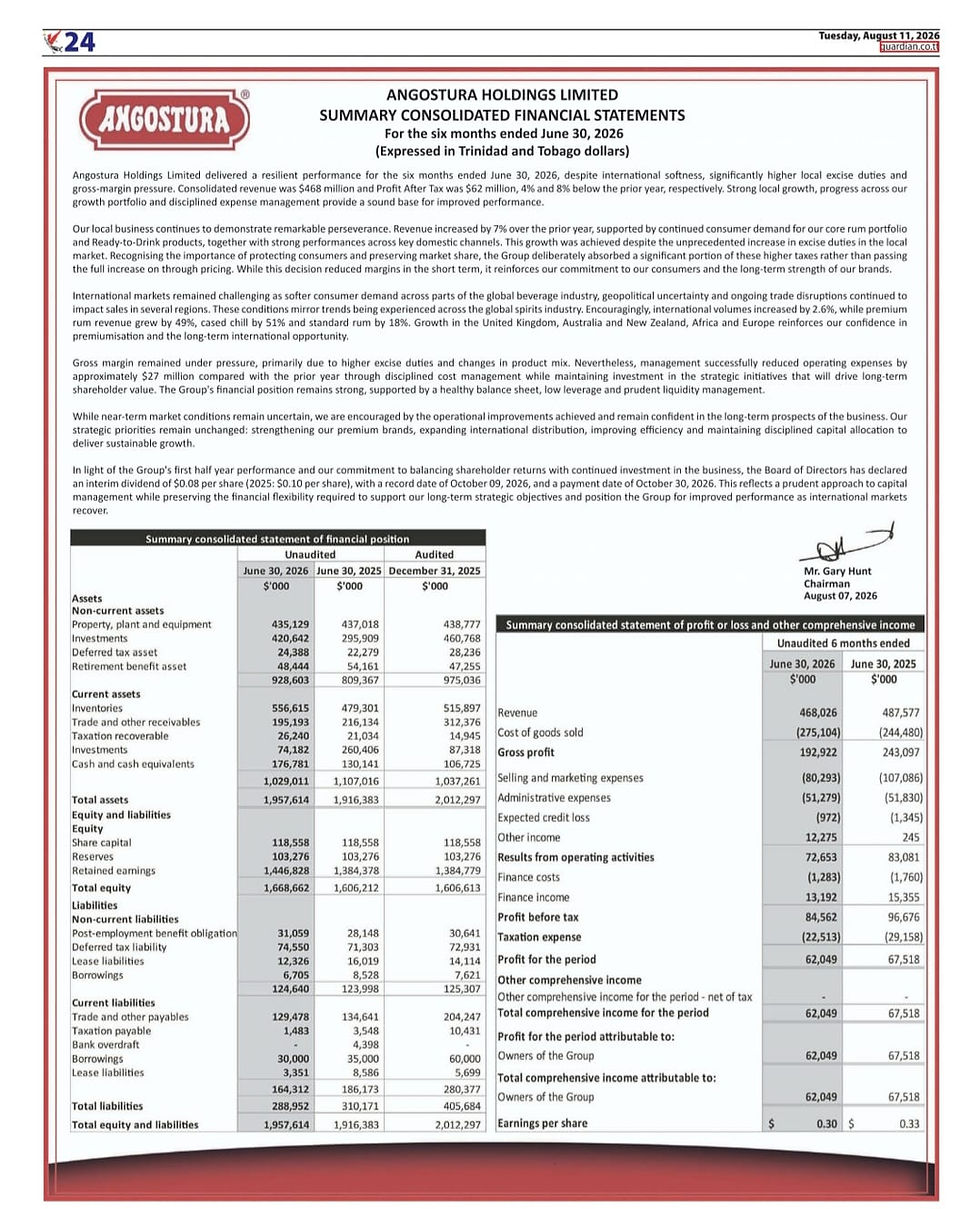
With roughly TT$672 million sitting in cash and investments, Angostura Holdings raises an important question for investors: when does financial strength become inefficient capital allocation?
Angostura Holdings Limited is one of Trinidad and Tobago’s most recognizable companies.
Its brands travel far beyond the Caribbean, Angostura aromatic bitters has an enviable global position, and the company has demonstrated an ability to generate meaningful profits from its core beverage operations.
So this is not an argument that Angostura is a bad business.
Quite the opposite.
It is an examination of something investors sometimes overlook when analyzing a good business:
What happens to the profits after they are earned?
Angostura’s latest financial statements make that question particularly relevant.
First, the operating results
For the six months ended June 30, 2026, Angostura reported consolidated revenue of approximately TT$468 million, down 4% from the comparable period, while profit after tax declined 8% to approximately TT$62 million.
The headline numbers, however, do not tell the whole story.
The domestic business remained resilient, with local revenue increasing approximately 7%. International conditions were more difficult, although international volumes increased 2.6%. Premium rum revenue increased 49%, while management also reported encouraging growth across several international markets.
Margins were pressured partly by significantly higher local excise duties. Management made the deliberate decision to absorb a portion of those increases rather than pass the entire cost to consumers, while simultaneously reducing operating expenses by approximately TT$27 million relative to the prior period.
There is therefore a reasonable operating case to make that Angostura is navigating a difficult period rather than experiencing a fundamental deterioration in its brands.
But the part of the financial statements that interests me most isn't the income statement.
It is the balance sheet.
The TT$672 million question
At June 30, 2026, Angostura held approximately:
TT$494.8 million of financial investments, together with approximately TT$176.8 million of cash and cash equivalents.
Combined, that is approximately TT$671.6 million of cash and investments. The Group reported total assets of approximately TT$1.96 billion.
In other words, roughly 34% of Angostura's total asset base consists of cash and financial investments.
That works out to approximately TT$3.26 per Angostura share.
For some additional perspective, AHL closed at approximately TT$10.65 on August 10, 2026, giving the company a market capitalization of roughly TT$2.19 billion. On a gross basis, therefore, its cash and investments represent around 31% of its market capitalization.
That does not mean Angostura could, or should, simply distribute TT$3.26 per share tomorrow.
Companies need working capital. Angostura carries significant inventories, has ongoing capital expenditure requirements, operates internationally, earns foreign currency, faces tax and excise obligations and may reasonably want liquidity for future expansion.
But when financial assets reach this scale, investors should reasonably ask:
How much capital does the operating business actually require?
This isn't just temporary excess cash
The size of the investment portfolio also did not suddenly appear in 2026.
At December 31, 2024, Angostura reported approximately TT$427.2 million of investments.
By December 31, 2025, that had increased to approximately TT$548.1 million. The 2025 portfolio included corporate debt securities and, importantly, approximately TT$63.4 million of listed equities held for trading. The annual report states that those equity investments were all listed within the MSCI All Country World Index. The company's investment assets were overwhelmingly denominated in US dollars.
Management provides a perfectly rational explanation for at least part of the strategy.
Angostura earns substantial US-dollar revenue from exports. Export revenue represented approximately 42% of Group revenue in 2025, and management says it invests a portion of surplus US-dollar earnings in short- and long-term instruments.
For a Trinidad and Tobago company, retaining some USD liquidity can have obvious strategic value. The question is one of degree. There is a difference between treasury management and having hundreds of millions of dollars permanently allocated to financial assets within an operating company.
And to be fair, the portfolio is making money
I would not characterize Angostura's investment portfolio as poorly managed based on the available financial information.
In 2025, Angostura reported approximately TT$20.5 million of investment income and another TT$11.3 million of fair-value gains on investments, with total finance income reaching approximately TT$32.4 million. Finance income had been TT$21.9 million in 2024.
That is real value. In fact, finance income represented approximately 15% of Angostura's TT$212 million of 2025 profit before tax.
So the question isn't:
Why is Angostura losing money investing?
It isn't.
The better question is:
Is earning financial-market returns inside Angostura the best use of Angostura shareholders' capital?
The opportunity cost of a strong balance sheet
Every dollar of retained earnings has competing uses.
Management can reinvest in the core business, expand production capacity, enter new markets, build brands, acquire another business, reduce debt, retain liquidity, repurchase shares where appropriate, distribute dividends, or invest the money in financial markets.
There is nothing inherently wrong with the final option.
But as the investment portfolio becomes larger, the hurdle for retaining that capital should arguably become higher.
Why?
Because Angostura's competitive advantage is not managing a diversified securities portfolio.
Its competitive advantage is its brands, intellectual property, production expertise, distribution relationships and position within the global spirits market.
An individual shareholder can buy bonds or a diversified global equity fund independently.
What the shareholder cannot easily replicate is ownership of Angostura's underlying operating franchise.
This is the central capital allocation decision.
Want content like this straight to your inbox? Join our mailing list below (opens in new window).
Join Mailing List
The ROE problem
This also eventually shows up in financial ratios.
Angostura's own 2025 annual report shows Return on Equity declining from 11.9% in 2021 to 9.5% in 2025, while Return on Assets declined from 10.0% to 7.6% over the same period.
It would be incorrect to blame that entire decline on the investment portfolio.
Operating margins, earnings, inventory, capital expenditure, asset growth and numerous other factors affect ROE and ROA.
But the mathematical principle remains important. If a company continually retains profits and adds them to its equity base, those retained funds need to earn adequate incremental returns. Otherwise, even if absolute profits remain healthy, returns on shareholder capital can gradually deteriorate.
Imagine a hypothetical operating company producing a 15% return on the capital deployed in its core business.
If it then retains progressively larger amounts of earnings that ultimately earn 4%, 5% or 6% in securities, the blended return on the company's total capital will naturally move lower.
The company may become financially safer. But it can simultaneously become less capital efficient.
There is a point at which having more money on the balance sheet stops being an unquestioned positive.
One Angostura disclosure deserves more explanation
There is another interesting detail in the 2025 Annual Report.
Angostura presents a five-year chart showing what it calls “Return on Investments (PAT)”, with the 2025 figure reported as 28.0%.
At first glance, an investor could reasonably interpret that as the return earned on Angostura's securities portfolio.
But consider the numbers. Angostura generated approximately TT$153.3 million of Group profit after tax in 2025 and ended the year with approximately TT$548.1 million of investments.
TT$153.3 million divided by TT$548.1 million is almost exactly 28.0%.
That suggests the metric is effectively Group PAT divided by the investment balance, not the investment portfolio's actual investment return.
If that interpretation is correct, I think shareholders would benefit from clearer disclosure.
Given the increasing materiality of the portfolio, investors should ideally be able to understand separately the portfolio's:
-actual investment return, realized and unrealized gains, benchmark, risk profile and strategic purpose.
That would make it easier to assess whether retaining this capital is creating more value than the alternatives.
What are Angostura's alternatives?
This does not necessarily lead to the conclusion that Angostura should immediately declare a massive special dividend.
There may be opportunities shareholders cannot yet see.
-Perhaps management is building resources for an acquisition.
-Perhaps there is a significant international expansion opportunity.
-Perhaps manufacturing capacity requires substantial future investment.
-Perhaps maintaining considerable USD liquidity is strategically valuable given Trinidad and Tobago's foreign-exchange environment.
All are plausible.
And that is precisely why communication matters.
If TT$500 million-plus of investments represents strategic dry powder, investors should understand broadly what management is preparing for.
If instead this is intended to be a permanent treasury portfolio, shareholders should be given enough information to evaluate the return objective and rationale for maintaining it.
The dividend makes the issue more interesting
Against this balance-sheet backdrop, Angostura's Board has declared an interim dividend of TT$0.08 per share for H1 2026, down from TT$0.10 in the prior-year period.
The record date is October 9, 2026, with payment scheduled for October 30.
Management described the decision as balancing shareholder returns with investment in the business while preserving financial flexibility for long-term strategic objectives.
Again, entirely defensible.
But when a company with relatively low leverage and more than TT$670 million in gross cash and investments reduces its interim distribution, the natural shareholder question becomes:
What exactly are we preserving the financial flexibility for?
It is not necessarily a criticism. It is a request for a clearer capital-allocation roadmap.
This is also a corporate governance issue
Angostura's ownership structure makes that question particularly important.
At December 2025, Rumpro Company Limited held approximately 44.97% of AHL, while National Investment Fund Holding Company Limited held approximately 29.97%. Together, the two largest shareholders therefore controlled just under 75% of the company's issued shares.
No allegation of improper conduct follows from concentrated ownership. But where ownership is highly concentrated, minority investors naturally have considerably less influence over corporate decisions.
That increases the importance of strong disclosure around decisions involving retained earnings, dividends and capital allocation.
The issue isn't simply:
Can management retain the money?
The better governance question is:
Why is retaining the money expected to create greater long-term shareholder value than returning it?
That is the standard against which capital allocation should ultimately be judged.
How global spirits companies talk about capital allocation
Angostura is obviously not directly comparable to companies many times its size, but the way larger global spirits businesses communicate about capital provides a useful reference point.
Campari's 2025 results explicitly link capital allocation to sustaining growth, streamlining its brand portfolio, reducing leverage and increasing shareholder distributions as cash generation improves.
Pernod Ricard similarly discusses capital deployment through capital expenditure, strategic inventories, portfolio management, dividends and debt management.
Diageo's latest strategy places considerable emphasis on free cash flow, capital discipline, deleveraging and selective asset disposals while seeking stronger shareholder returns.
The lesson isn't that Angostura should copy any of them, it is that shareholders benefit when management clearly explains where capital ranks among competing uses and why.
Could the balance sheet attract a buyer?
There is another argument sometimes made about businesses carrying substantial excess financial assets: that it makes them attractive acquisition targets.
That idea needs some qualification. Cash isn't free to an acquirer. A rational buyer should ultimately pay for the financial assets through the value assigned to the company's equity.
But an inefficient balance sheet can create an opportunity.
If an investor believes the operating business is undervalued because significant capital is trapped in low-return assets, there may be an opportunity to acquire or influence the company, restructure the balance sheet and redeploy or distribute excess capital.
In deeper capital markets, that is often the territory in which activist investors become interested.
The problem is therefore not simply that Angostura has cash.
It is whether the market believes management can generate an adequate return on all of the capital shareholders have entrusted to it.
What investors should learn from Angostura
For me, the bigger lesson goes beyond this particular company.
When analyzing any stock, investors should look beyond revenue growth, EPS and dividends and ask:
How much capital is actually required to operate the business?
What returns is the core business producing on incremental capital?
What is management doing with retained earnings?
Could shareholders earn a better risk-adjusted return if surplus capital were distributed to them?
Has management clearly explained its capital-allocation priorities and the return hurdles it uses?
These questions become increasingly important as companies mature. A business can remain profitable for decades while becoming progressively less efficient at allocating the profits it generates.
My view on Angostura
I continue to see Angostura as fundamentally a strong operating franchise. Its globally recognized bitters business, rum brands, export potential and domestic market position have real economic value. Its relatively conservative balance sheet also provides resilience during periods of economic or industry stress.
My concern is narrower.
With approximately TT$672 million now represented by cash and investments, investors deserve greater clarity about Angostura's long-term capital-allocation framework.
-What level of liquidity does management consider necessary?
-What proportion of the investment portfolio is strategic?
-What return is expected from that portfolio?
-What potential acquisitions or expansion opportunities justify retaining the capital?
And, most importantly:
At what point does capital that cannot earn an attractive return inside Angostura belong back in the hands of Angostura's shareholders?
The strongest balance sheet is not necessarily the one containing the most cash.
It is the one in which every dollar has a clearly defined job.
And ultimately, capital belongs wherever it can earn the highest appropriate risk-adjusted return for its owners.
What this means for your own portfolio
The same principle applies to personal wealth.
Owning good investments is only part of building wealth. The bigger question is whether your entire portfolio is structured so that each dollar is doing the right job- across equities, fixed income, cash, real estate and different currencies.
Many investors I work with already own good assets. The challenge is often coordinating those investments into a deliberate portfolio with the right balance between growth, income, liquidity and risk.
Through WealthwithDaniel, I work with professionals, business owners and families who already have capital invested and want a more structured, long-term approach to managing their wealth. My approach combines institutional investment thinking, multi-asset portfolio construction and practical financial decision-making.
Most relationships begin with a financial planning and portfolio review session, where we examine your existing holdings, identify gaps or inefficiencies and define a clearer investment direction. From there, we can determine whether ongoing portfolio and wealth management is appropriate.
If you're already investing but aren't sure whether your portfolio is truly working as efficiently as it could, you can book a planning session with me through WealthwithDaniel.
Because whether we're talking about a TT$2 billion public company or an individual's investment portfolio, the principle is the same:
Capital should have a purpose.
As always, no pressure, just perspective.
-Daniel Tittil, CFA, CAIA, MSc.
Lead Advisor at WealthwithDaniel.com
Chief Investment Officer at Legacy Wealth Management (Cayman) Ltd.
Portfolio & Wealth Manager, Director at Admiral Capital
Want content like this straight to your inbox? Join our mailing list below.
This article represents the author's analysis and opinion based on publicly available information and is intended for educational purposes. It should not be regarded as a recommendation to buy, sell or hold Angostura Holdings Limited or any other security.


Comments