

Investment Idea: Capital Protected Exposure to the AI Revolution
- Daniel Tittil
- Feb 20
- 4 min read

Updated: Feb 26
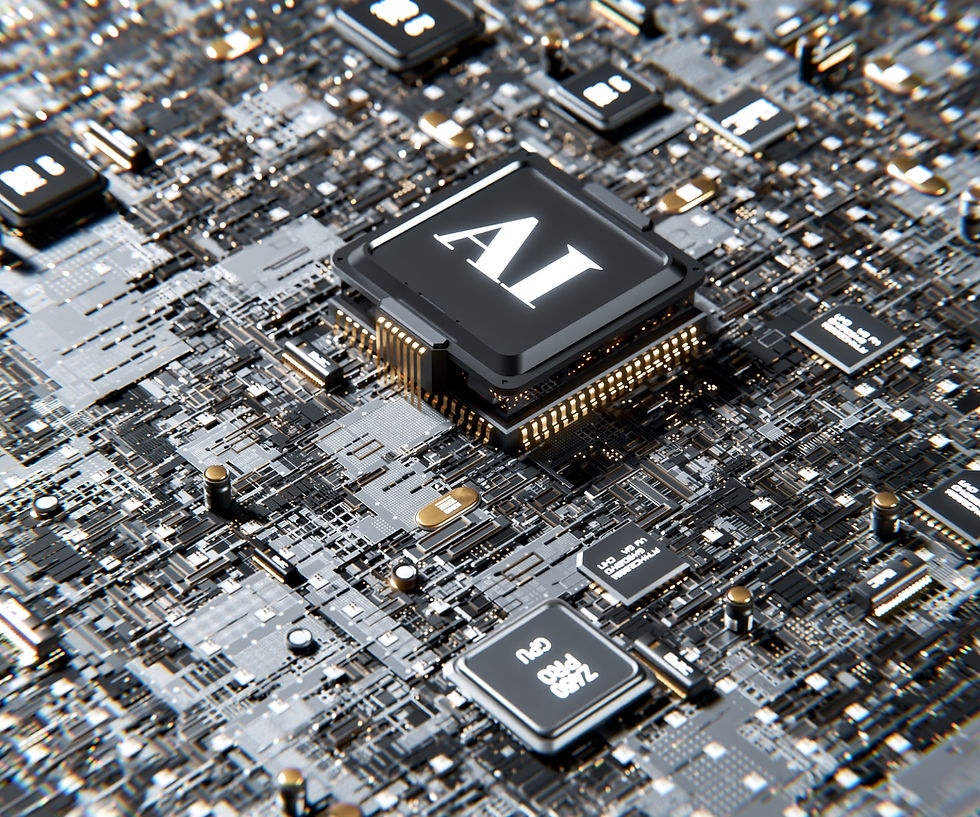
Artificial Intelligence is no longer a niche theme.
It is reshaping semiconductor design, data center architecture, enterprise software, cloud infrastructure, and even advertising economics.
But here is the problem many high-net-worth investors face:
You want exposure to AI…You recognize the long-term structural opportunity…Yet you are uncomfortable with full equity downside risk.
This is where structured solutions can become powerful portfolio tools.
Recently, I reviewed a 36-month USD capital protected note linked to an equal-weighted basket of nine global AI leaders. It is designed to provide:
103% capital protection at maturity (equivalent to ~1% p.a. guaranteed return)
100% participation in upside
Equal-weight exposure across the AI value chain
Below, I’ll walk through:
How the structure works
The companies inside the basket
What Morningstar says about each
Key risks
Why this can be compelling for conservative AI exposure
How variations can be customized
The Structure in Plain English
This is a 3-year capital protected note.
At maturity, the investor receives:
103% + any positive performance from the basket (subject to structure terms).
There is also a feature where, if any individual stock doubles (+100%) during the life of the note, its contribution is locked at +20%.
This mechanism:
Can protect gains if a stock spikes and then falls
Can cap upside on an explosive single winner
The basket is equally weighted across nine AI-related equities:
Nvidia
TSMC
Broadcom
Vertiv
AMD
Meta
Micron
ASML
Tokyo Electron
The note is issued at a minimum size of $500k (although smaller sizes are negotiable).
The AI Basket: Company Breakdown & Morningstar View
This is not just “AI hype.” The basket spans chips, foundries, tools, infrastructure, and applications.
Let’s walk through each.
1. Nvidia (NVDA)
Nvidia is the dominant AI infrastructure supplier globally.
Morningstar assigns:
Wide economic moat
Strong financial position
Leadership in GPUs and the CUDA ecosystem
The key here isn’t just hardware. It’s CUDA; the proprietary software layer that creates powerful switching costs.
Risk factors:
Customer concentration (hyperscalers)
AI spending cyclicality
Geopolitical limits (China)
Nvidia remains the “center of gravity” in AI training.
2. TSMC (TSM)
TSMC manufactures chips for Nvidia, AMD, Apple, and many others.
Morningstar assigns:
Wide moat
~70% foundry market share
Structural cost advantages
AI and high-performance computing are major long-term growth drivers.
Risks:
Cyclicality in semiconductor demand
Massive capex requirements
Geopolitical tensions
Without TSMC, the AI chip ecosystem stalls.
3. Broadcom (AVGO)
Broadcom is both an AI networking chip powerhouse and a strong software cash-flow generator.
Morningstar assigns:
Wide moat
Excellent capital allocation
Strong free cash flow margins
AI networking and custom accelerators are key growth drivers.
Risks:
Customer concentration
Acquisition execution risk
Broadcom benefits from AI data center buildouts; especially networking intensity.
4. Vertiv (VRT)
Vertiv provides cooling and power management for data centers.
Morningstar assigns:
Narrow moat
Very High Uncertainty rating
Heavy reliance on data center spending
Over 80% of revenue tied to data centers.
Risks:
Capital spending volatility
AI infrastructure overbuild
Vertiv is a leveraged play on AI data center expansion.
5. AMD (AMD)
AMD is the primary challenger to Nvidia in AI GPUs.
Morningstar assigns:
Narrow moat
Strong data center growth potential
AI accelerator TAM > $500B by 2028
Risks:
Competing against Nvidia’s CUDA ecosystem
Execution risk in AI chips
AMD provides second-source optionality in AI acceleration.
6. Meta (META)
Meta is the AI application layer.
Morningstar assigns:
Wide moat
Nearly 4 billion monthly active users
Massive AI-driven ad targeting improvements
AI enhances monetization through better ad performance and user engagement.
Risks:
Regulatory action
High AI capex
Reality Labs losses
Meta monetizes AI; not just builds infrastructure.
7. Micron (MU)
Micron supplies memory; including high-bandwidth memory (HBM) critical for AI workloads.
Morningstar:
No moat
Highly cyclical
Benefits from HBM AI demand
Risks:
Commodity pricing
Cyclical downturns
China exposure
Micron is the cyclical memory exposure in the basket.
8. ASML (ASML)
ASML is the only company capable of producing EUV lithography machines.
Morningstar assigns:
Wide moat
90% market share in lithography
Extremely high switching costs
EUV tools are essential for leading-edge AI chips.
Risks:
Export controls
Semiconductor cycles
Valuation risk
ASML is arguably one of the most defensible companies in the semiconductor ecosystem.
9. Tokyo Electron (8035 JT)
A leading semiconductor equipment provider.
Morningstar assigns:
Wide moat
Strong front-end process presence
Heavy R&D investment for next-generation nodes
Risks:
Industry volatility
Competition from Applied Materials and Lam
Tokyo Electron benefits from increasing chip manufacturing complexity driven by AI.
Why This Structure May Appeal to HNW Investors
If you were to buy these nine stocks outright:
You assume full downside risk
You are exposed to semiconductor cyclicality
You face valuation volatility
With this capital protected structure:
✔ You receive at minimum 103% at maturity (subject to issuer credit risk)
✔ You participate 100% in upside
✔ You diversify equally across the AI value chain
✔ You reduce behavioral risk during volatility
For conservative portfolios that want AI exposure without sleepless nights, this can be powerful.
Key Risks to Understand
Capital protected does not mean risk free.
Here are the main risks:
1. Issuer Credit Risk
Protection depends on the issuing bank’s solvency.
2. Liquidity Risk
Secondary market liquidity can be limited.
3. Opportunity Cost
If AI massively outperforms and individual names triple, caps may reduce maximum participation.
4. Early Barrier Mechanics
If a stock hits +100% and locks at +20%, you forgo additional upside from that name.
5. AI Spending Cyclicality
AI infrastructure spending could slow.
6. Geopolitical Risk
US-China tensions affect semiconductors.
The structure mitigates equity downside but does not eliminate structural risk.
Customization Possibilities
One of the most attractive aspects of structured solutions is flexibility.
Possible variations:
90% capital protection with higher participation
Longer tenors (5–7 years)
Auto-call features
Commodity or ETF underlyings
Thematic baskets (AI + energy transition, for example)
Partial capital-at-risk versions for enhanced yield
Structured solutions are not one-size-fits-all.
They are engineered tools.
Final Thoughts
AI is likely to remain one of the defining investment themes of the decade.
But participation does not require reckless exposure.
For high-net-worth investors seeking:
Downside discipline
Defined maturity outcomes
Participation in structural growth
Intelligent portfolio construction
Capital protected thematic notes can be compelling.
If you are interested in exploring whether a structure like this fits within your broader investment strategy, you can contact me via the Contact Us page at www.wealthwithdaniel.com.
As always, thoughtful allocation beats emotional allocation.
-Daniel Tittil, CFA, CAIA, MSc.
Lead Advisor at WealthwithDaniel.com
Subscribe for future blog posts via the homepage https://www.wealthwithdaniel.com/


Comments